
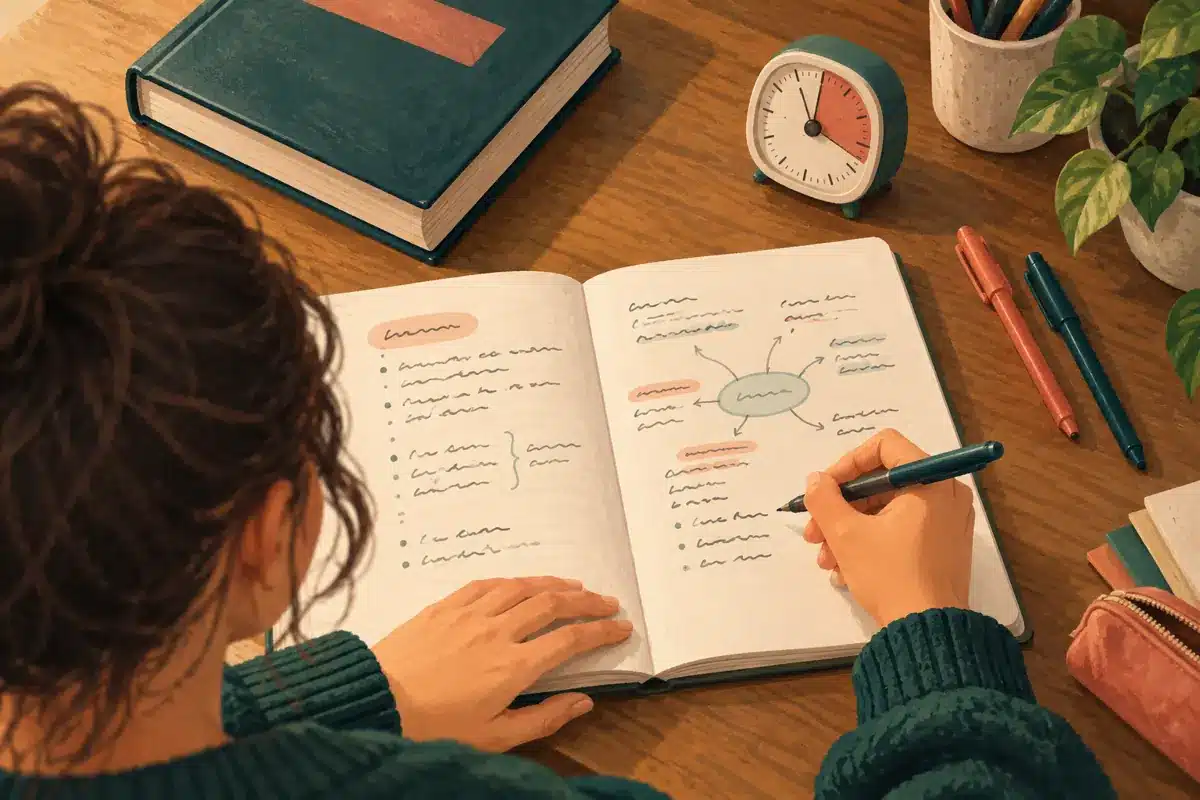
You read the paragraph again. It makes sense. You highlight a sentence, turn the page, and feel reasonably prepared. Then someone asks you to explain the idea without the book, and the answer disappears.
That gap is what the blurting method is useful for finding. Review a small topic, put the material away, write or say what you remember, then check and correct it. The messy first attempt is information about what needs work—not a verdict on how clever you are.
You need something to write on, your course material, and a question small enough to answer. No new app required.
What is the blurting study method?
Blurting is an informal name for a blank-page recall routine. Instead of keeping the answer in front of you, you try to produce it yourself. Then you compare your attempt with a reliable source.
Cornell’s Learning Strategies Center describes a closely related technique as blank page testing: recalling ideas in writing or diagrams to uncover gaps in understanding. The useful part is the attempt to remember, followed by an honest check—not filling an impressive-looking sheet.
There is one important boundary: you need some initial understanding. If the lecture never made sense, begin by working through an explanation or asking for help. A blank page cannot supply an explanation you have not learned yet.
Try this 15-minute blurting routine
Pick a narrow target: “explain opportunity cost with one example,” rather than “revise economics.” If starting is the problem, use our 10-minute study reset to make that first action smaller.
| Minutes | What to do | What stays on the page |
|---|---|---|
| 0–3 | Review one small topic. | A heading and one question. |
| 3–7 | Close the source and recall. | Your explanation, sketch or steps. |
| 7–11 | Check against the source. | Corrections marked clearly. |
| 11–14 | Close it again; retry the gaps. | A fresh answer to the weak point. |
| 14–15 | Choose a later check. | A question and a review date. |
1. Review enough to know what you are trying to retrieve
Read one short section or study one worked example. At the top of a fresh page, write a prompt. Make it specific: “How does this process work?” or “What would count as evidence for this interpretation?”
2. Close the material completely
Write the explanation in your own words. Use arrows, fragments or a rough diagram if that is easier. Leave a question mark where you get stuck. Checking every few seconds turns the session back into copying.
If handwriting slows you down, type with the source window closed or explain aloud and make a few brief notes afterward. Choose a format you can actually use.
3. Check errors, not just omissions
Open the source and mark what was missing, inaccurate or unsupported. A second pen colour can help, but plain labels work too: “missing,” “wrong,” and “needs evidence.” Do not give yourself credit for a confident sentence that says the wrong thing.
UC San Diego’s retrieval-practice guide recommends setting materials aside, attempting recall, checking the original material and repeating the process. Checking is part of the work, not an optional tidy-up.
4. Retry one weak point on a clean space
Close the source again and answer the question you missed. Do not rewrite the entire sheet merely to make it neat. Finish by choosing when you will test that question again.
A worked example: revising an unreliable narrator
Blurting method example at a glance: For a literature revision question, first write from memory: “An unreliable narrator always lies.” Next, check your notes and mark the error: a narrator may be mistaken, biased or limited rather than deliberately dishonest. Finally, close the notes and retry: “An unreliable narrator gives an account readers have reason to question; I should support that interpretation with evidence from the text.” This first attempt → check → corrected recall sequence is the core of blurting revision. The example is illustrative, not a universal definition of every narrator.
This is a fictional study example, not a report of a student test. Suppose your seminar covers the difference between an author and a narrator, and how a narrator’s account might be unreliable.
The prompt: “What would make me question this narrator’s account, and how would I support that reading?”
Your first blurt: “An unreliable narrator lies. The narrator is the author’s voice. If an event sounds strange, the narrator must be wrong.”
That answer gives you three useful things to check. Does unreliability always mean deliberate lying? Have you confused the person telling the story with the person who wrote it? What evidence would justify your interpretation, rather than merely your feeling that something is strange?
The repair: After checking your seminar notes, write a clearer distinction between author and narrator. Add a specific passage from the assigned text that supports your reading, then note a plausible alternative interpretation.
The second prompt: “Explain my reading in three sentences, with one piece of evidence and one limitation.”
Now you are practising an answer you might actually need in an essay. Remembering a definition is a start; choosing evidence and defending a reading is another task.
Does the blurting method actually work?
The research supports retrieval practice, the broader process behind this routine. In Roediger and Karpicke’s 2006 experiments, students who practised recalling prose showed better retention on delayed tests than students who repeatedly studied it. That finding does not establish that every version of “blurting,” or this exact 15-minute schedule, will work equally well.
Carnegie Mellon’s overview of retrieval practice also describes quizzes, flashcards and practice problems as ways to retrieve information. A blank sheet is one option, not the only legitimate way to study.
Judge a session by what you can explain or do afterward. Page count, pen colours and how productive the exercise feels are much less useful checks.
What if your mind goes blank?
Shrink the task before abandoning it. Write three headings from the topic, turn each into a question, and try one. If nothing comes, study a smaller section and have another go. You are looking for a manageable stretch, not a competition in how long you can stare at paper.
- You remember isolated words: explain the link between two of them.
- You can recite a definition: add an example and a non-example.
- You keep making the same mistake: work through why the correct answer differs from yours, then retry later.
- You never reach the checking stage: shorten the recall period. A checked half-page is more useful than an unchecked pile.
Adapt it to the subject and the exam
For maths: recall a method, then solve an unfamiliar problem and check the working. Listing formulas alone does not practise choosing and applying them.
For biology or another process-heavy subject: draw the stages from memory, label the relationships, then compare them with the course diagram. Check the arrows as carefully as the names.
For essays: practise a claim, supporting evidence and a counterargument. For languages, produce a sentence or answer a question rather than only naming vocabulary.
Use your lecturer’s learning outcomes and permitted practice questions to decide what deserves attention. If the test requires problem-solving, give problem-solving time in the plan.
How often should you use blurting?
Use a short session to find gaps, then revisit the important questions after a gap rather than immediately copying the corrected answer again. Cornell recommends spreading practice across separate sessions. The right interval depends on your deadline, the material and what you can still retrieve.
For an exam next week, you might check a topic today, try it again tomorrow, and revisit it a few days later. That is a sample plan, not a fixed rule. Move on from a question when you can answer it accurately and apply it; bring it back if the answer falls apart later.
A simple timer is enough. Our Pomodoro app comparison can help if you already want a timer, but setting up a new system is not a prerequisite. If missing coursework is competing with revision, triage the assignment backlog before building an unrealistic exam plan.
Quick questions
Is blurting the same as active recall?
Blurting is one way to practise active recall. Flashcards, answering practice questions and explaining an idea without notes are other ways. Choose the format that matches what you need to learn.
Should I write everything I remember?
Start with everything relevant to a small prompt. An unrestricted whole-chapter dump can become difficult to check. A narrower question makes it easier to notice a missing step or a weak explanation.
Can I use AI to check my blurt?
Use your course material and marking guidance as the reference. An AI-generated correction can itself be wrong. Follow your institution’s AI rules and do not upload private or restricted course material. You can do the whole exercise without AI.
Your next session
Choose one question you would dislike seeing on the exam. Give it a small patch of paper. Try an answer with the notes closed, check it, and repair one gap. That is enough to make the next fifteen minutes more specific than “do some revision.”
After a demanding recall session, take a short break before reviewing another topic. Our guide to useful study breaks explains how to pause without losing momentum.
Try it, then tell us: which part was harder—remembering the idea, explaining it, or checking whether it was right?
Make active recall part of your study routine: Use the Study Focus Hub to plan a focused work block, reduce interruptions, take a useful break, and then test what you remember with blurting.
Sources checked October 22, 2026. The timings and worked example are RestMint’s practical illustrations; they are not a validated study protocol or a guarantee of exam results.
Leave a Reply